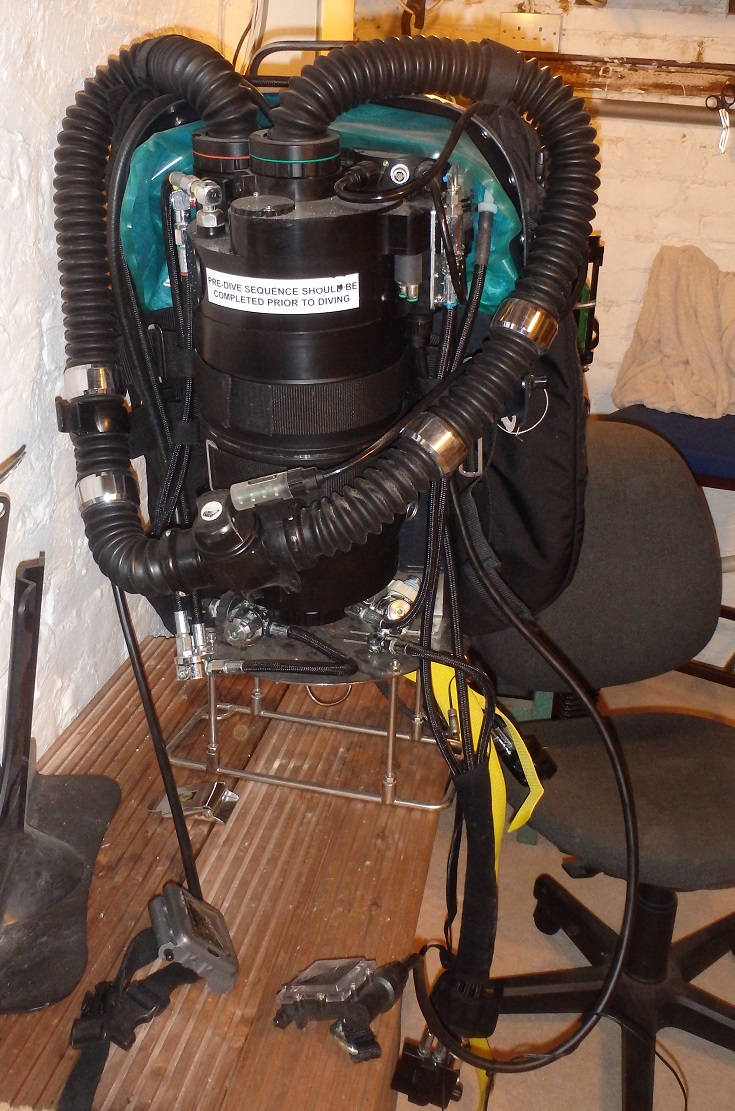
Sentinel Rebreather
stand
OK so why, after all these years on the Inspiration, did I go out and buy a
Sentinel?
Well don't get me wrong. There are a lot of good features on the Inspiration
and we've done a lot of happy hours in the water together. The Vision upgrade
was a success and I had quite expected to carry on diving the thing until they
pulled my medical certificate and I have the diving garage sale of the century.
Well like every other good you're been dumped story it starts
it isn't you, it's me.
I'm getting old. I can't recommend it but the alternatives don't really look so
hot either so I just have to put up with it. The sort of places I want to go
underwater these days sometimes involve substantial deco stops and I'm not the
kind of hero that will take an Alpinist route and assume that incidents only
happen to other people. I want some bailout gas so when something important
breaks I'm getting back to the surface intact if a bit annoyed. However as the
dives get more interesting the quantity of bailout gets bigger and bigger and I
just can't manage it any more.
The Inspiration harness has defeated me. In big chunky gloves I cannot kit-up
two big stages and the works. I tried some billy-rings and then debated a total
reharness job but I wasn't quite sure what I wanted so I started looking at
other rebreathers just to see what had been done. I wasn't looking for a new
rebreather just for ideas to steal.
I blame Dave. Dave Cooper that is of
Zero Gravity Diving. I was doing a
course with him and the shore diving techniques he uses for his dive sites in
Lake Geneva showed up all my problems. Now I admit I never shore dive. I live
in Brighton and if you could get into even mildly deep water inshore the
Victorians would not have spent oodles of boodle building great long piers to
get access to ships. However I wasn't just out of practice I was beaten. In
free water I can unship a stage and swap it for another, I've done the team
bailout drills, but clambering into shallow water the floppy D rings hid
from my fingers while my poor little arms and trashed shoulder joints can't
reach far at the best of times so it just didn't work.
Dave waited patiently but suggested trying either of the two rebreathers that
are his current 'choice'. The rEvo or the Sentinel. Now I'd watched them
setting both of these up and the engineer in me swung towards the Sentinel. He
offered and I did the try dive and went home and thought about it. I'm not
going to claim it was the most thought through decision but I decided I'd buy
the ready made solution rather than tackle the serious rebuild.
So I am now the possessor of Sentinel number 104 and I did the crossover for my
IANTD Mod 2 with Dave and Phil in Geneva. It was a good, thorough course with
lots of drills, lots of help and advice but, as ever, the day comes when you
have to set out on your own...
So what do I like about it?
I like the design concept as a diving machine. I have some problem but I see
them as adjustments to suit me rather than deviations from the fundamental
design. Remember I'm the guy who dived inverted twin 300bar 10s when the
concept was pure strokery. The Sentinel has the ADV and the DSV that I had to
buy as add-ons to the old Inspiration as standard. It has monitoring on the
scrubber which I liked when they introduced it on the Vision. It has shut-offs
on both the ADV and the solenoid so you get away from the O2 inject via
cylinder valve, well unless the first stage lets go. Some people rave about the
'clear front' like it was useful - I want the things on my front that I need
instant access too so that is the injectors, shutoffs and stages. I wouldn't
have a problem with counterlungs because after seven years I'm used to
them.
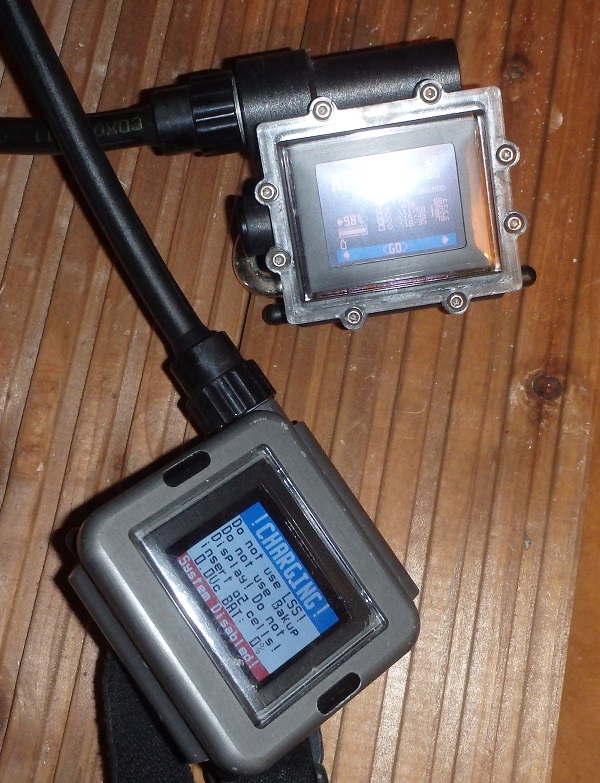
The secondary display is wonderfully obvious with its three ppO2s readouts
calibrated by 'penny screws' in the head and the raw millivolt numbers
available. You wonder why all the others don't have a similar trick. There are
quite a few 'blinding flash of the obvious' features in the design and I like
that.
Low tool maintenance from design planning. Most things are finger tight,
gee I must remember to refinger tighten them, although, aside from when the
airport security at Kirkwall confiscated my nice stainless 180mm/104gram
adjustable wrench because I might undo the bolt that holds the wings on or
something, I normally have spanners.
I like the clunk together construction of the scrubber and the hose
fittings.
The loop is strange in that the exhale goes to the top of the scrubber and
soaks through the stack to the OPV at the bottom. Flip upright, go to maximum
loop volume and blow and the drysuit dump valve fitted to the bottom of the
scrubber can dumps the water first. The idea of putting water down through the
stack seems strange but I've seen enough Inspirations with a lot of water in
the bottom of the can that have worked perfectly. Certainly water is part of
the reaction and a by product so it doesn't interfere with the chemistry. I can
see I'm going to have to risk a big splosh of water down the pipe and see what
happens. The philosophy seems good, it's just not quite what I'm used
too.
The gas flow is then up the outside of the scrubber to the top again where
the inject, ADV and cells are. The hoses are on big chunky fittings and the
single exhale counterlung is at the back of your neck.
The rechargeable batteries are sealed inside. There was a lot of discussion on
the Inspiration about batteries off-gassing into the loop and there was no way
the case could seal when ambient goes up and down by 6 to 10 bar plus they were
camera batteries and 'for human consumption' was probably never in their design
spec. This one is sealed away and charges through the download plug. What is
more you can get the 'Power Monkey' battery based charger for it so you can
carry a charge to the rebreather rather than carry the rebreather to a mains
point. The geek in me had to have the solar powered version, why I don't know,
I'll never need it.
OK and I confess to a weakness for Swagelok parts. It's probably symptomatic of
my Steam-Punk tendencies. We have a Swagelok account at Combro and the
catalogue is pure engineer porn. You didn't know it existed before you saw it
on the page, you're not quite sure what you'd do with it but now you see it you
want it so badly.
I have the gas connect kit. Nice snap together feeds so you can swap out a tank
and its first stages and stay on the computer. OK it drove me mad. The
connectors wanted to stick out horizontally and foul the breathing loop. I'm
not quite sure how I'll rig it but I have some 300bar 2L carbon wound cylinders
and they'd make idea fallback. I'm hoping to rig one for the suit inflate so we
shall see...
So what do I not like?
The manual. Well if you know the VR3 manual it is a bit better. The problem is
that the conceptual, background reading stuff is all jumbled up in the
instructions. Even for something simple like turning it on there is a page or
so of discussion as to why wet-contacts aren't as good as the breathing
detection system they offer to wake it up but nowhere does it tell you that
normally you push and hold both buttons to start the set-up process. This is
very frustrating pre-reading things before the course when you don't already
know and suddenly you are jumped into mid sequence.
Actually you can never turn it off because people have won Darwin Awards
breathing a dead rebreather so it sits and flashes its red light every sixty
seconds to warn you that it doesn't have an elevated ppO2 so breathing it might
be a bad idea. Get real. It gets annoying when it's sitting on your hotel desk
after an all evening cruise through the manual and you're now trying to sleep.
The handset bags come in very handy here. The spare HUD tucks in nicely under
the counterlung because you only need it for courses and banging through a
wreck it is just going to get ripped off and risk becoming an Inspiration
imploding buzzer short circuit style problem.
The scrubber monitor. Nice in theory but, as I did my first few dives on manual
control, the clever clever algorithm that measures the O2 injects to work out
the scrubber use must have thought I was dead so it estimated a very low
scrubber usage. Frankly a dumber system tells me more because if it makes
errors that basic can I really trust it in real life? We are talking 90 mins in
the water giving 16 minutes stack usage on manual verses 61 minutes in the
water mostly on automatic giving 52 minutes usage. Maybe we need an electrical
switch to inject O2 via the solenoid to keep the poor thing on team or perhaps
I just have to learn to ignore the numbers and watch the colours. I don't want
to push the scrubber but put yourself in the situation with a buddy with a
fault decoing on OC trimix bailout and you want to stay with him? A rebreather
should be just the tool for this as you can overrun your time shallow while you
have gas provided you know the scrubber is still on team.
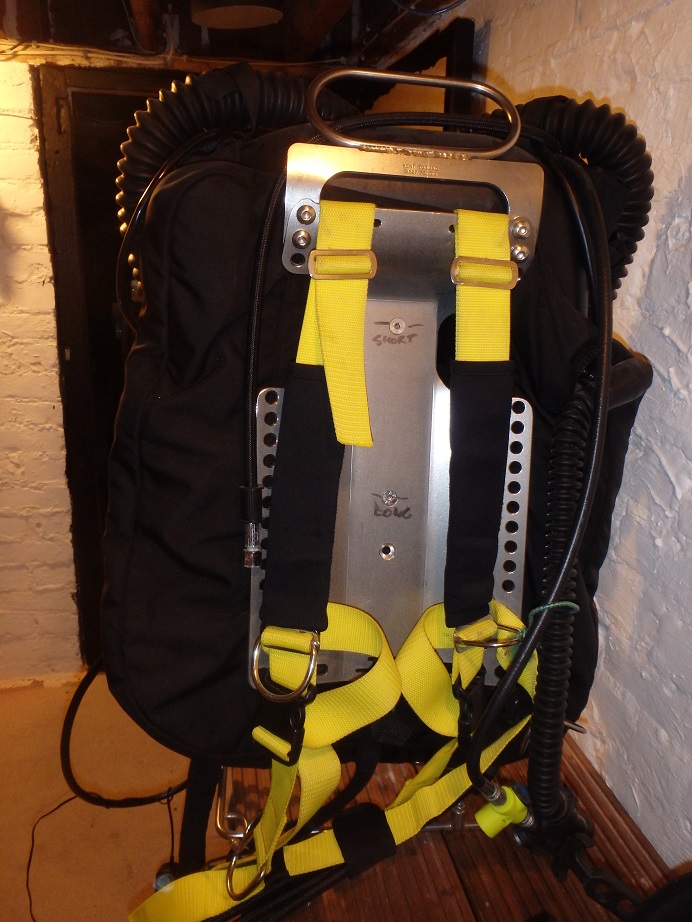
What were they smoking when they designed that back plate? The behind your neck
counterlung might need some protection so the whole system doesn't end up
hanging on the plastic but the bolts that hold the fabric handle on are M8
stainless so you could hang over a ton on them. The first time I felt those
nuts pressing into my shoulders I thought I had a piece of the harness trapped
behind me resulting in a very silly conversation. Then you realise the plate is
far to short and the waist strap is a tummy strap and the weight digs into your
kidneys rather than sitting solidly against the big bones of your
pelvis.
Then you try to put it on and discover that it needs a house-brick or three
bungeed to the bottom as it doesn't reach what you are sitting on so the weight
is always on you. I sat on a wall to kit up for the last day of the crossover
and the rig rocked back so I could get it on but then I was trapped. You need
somebody to pull your hand to rock you forward so you can get the weight over
your legs before you can stand up.
While we're on the subject of the harness the material is far too stiff. Having
pull-to-tighten style ends on the chest clips only works if you can actually
make the stuff slide through them. I had to undo the clip and feed it through
in stages.
The chest mount injectors and shut-offs are a nicely thought out idea. Pity
about the implementation. If they were on your upper chest they would provide
easy access to important functions. Sticking out from your shoulders they
don't. The DIL side works a bit better as the funny round manifold can pull up
and give you a bit more hose length but the O2 hose goes straight to the first
stage and so is not negotiable for length. Also the bundles of three hoses are
wrapped in a sleeve that loves to slide down over the shut off sliders so I
can't rely on doing that one handedly. However I suspect that can be fixed by
punching a zip tie through the material.
Calibrating sensors in air as "Air is a known gas." which means, I suppose,
that if you measure the air pressure as 1000mBar the oxygen pp is 209.5mBar.
However that is sound bite physics and at 100% humidity and 45°C, ie a good
tropical afternoon, the oxygen is 189mBar. Instantly 10% out. Fortunately the
cells will read high as I'd far rather get bent than end up dancing the oxygen
fandango. In the UK it's a better trick but as an option please. If I have any
known gas I would like to be able to use that. The number of 9s in the
percentage on the O2 I normally use makes air look pretty dubious stuff.
However I do take the point that you don't have to calibrate as often as I did
with the Inspiration.
Velcro. Velcro is a cop out from doing a job properly. It never works well but
it is enough of a bodge to make do. I really didn't think it was possible but I
do believe it has more Velcro bits than the Inspiration. They managed to make
so many bits clunk-click together beautifully and then resort to Velcro tabs
all over the outside. I either need to cry or to kill somebody. I haven't quite
decided which yet.
The DSV/BOV. Now I'm a great believer in DSVs and I was pleased that the system
came with one but I was sadly disappointed with it in use. Now on the
Inspiration I have a Bob Howell unit and it was admittedly a bit chunky but it
was always smooth and easy to use. This one is not. It is very stiff, it is
surrounded by other things and it is hard to get any grip on. Both the HUD and
the Poseidon bailout regulator stick out further than the twist to seal knob.
It is 57mms in diameter and the cut-outs are only 12mm deep and it requires a
staggering 180Ncm to move after it's been sitting a while. I don't think there
could be a worse shape than those curved shallow sides to grip in cold water
gloves. Something Bob shaped could be coming off the NC mill at Combro once
I've worked out what is best.
Black. I guess poor old Mr. Gurr was stuck with that one as a lot of divers
think that black is the height of techie fashion and the rest can't agree on a
colour (although Martin Parker seems to have done the job on yellow). This also
makes it a total bitch to photograph. I will settle for promising myself that
every mod I make will be an interesting colour. However Fatima in her burkha as
a logo... On the rebreather it's just a sticker but branding it into the box
with a hot iron is unforgivable. In black to add insult to injury.
And then there is the PC software. Are there words for this? Silly skins taking
up half the area and size dragable boxes that don't drag their internals so
you're stuck with little windows on modern big screens. However it's a nice old
.mdb database file, kept in the program files tree to protect it from
being backed up I suppose, so it will quite easy to read and display. However
if you drag through the procedure to actually edit in a site name for instance
as soon as you close Prolink and reopen it it's gone. You wasted your time.
This mess hasn't even been tested for the most basic of functionality. What
happens if you have both a VR3 and a Sentinel I don't know. Currently I'm
downloading one onto the laptop and the other on the desktop because I don't
see a way to tell them apart. I had to write something and Christmas, needing
an excuse to not decorate the bathroom, I came up with
this.
It still has a long way to go but us geeks need our graphs. Feel free to test
it for me and laugh at me when bits of it don't work.
What on earth happened on the dump here I don't know but I clearly wasn't
concentrating as I don't remember doing anything like that. I wondered where
the 21 meter stop came from.
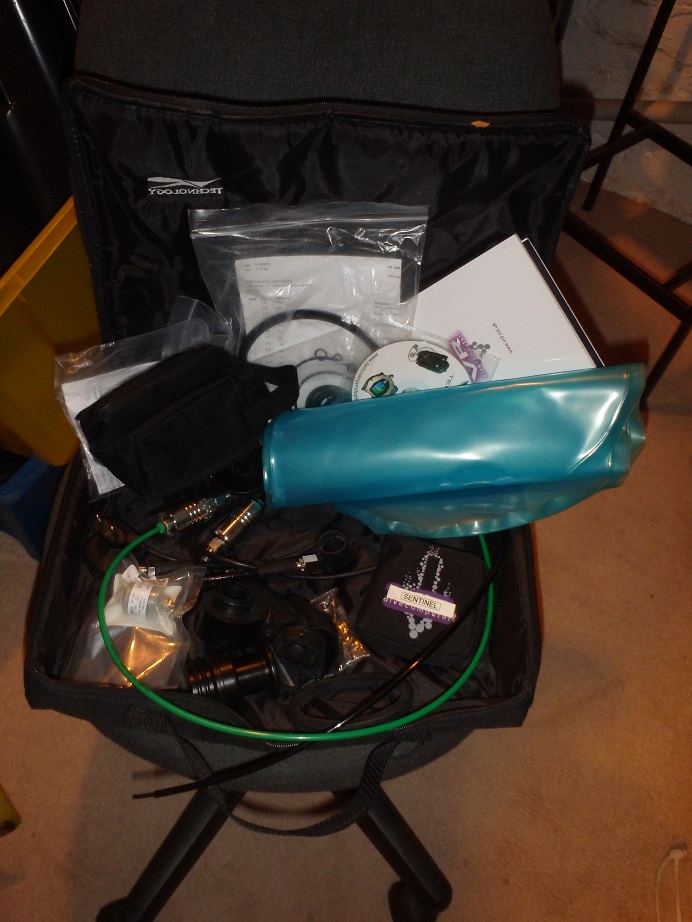
The case cover. It doesn't fit, it doesn't even want to fit and when you
finally get things arranged to its approval there is a five kilo load on the
rubber case handles. Plus the fact that I know that it's just biding its time
so it can catch me out not checking carefully enough and chomp the counterlung
to death. However I know the trick on that and I ordered a spare. Nothing ever
breaks if you have a spare.
Well some how the don't like section has ended up bigger than the
like section and that probably gives the wrong impression. I like what I
see and I didn't buy the Inspiration to just dive it as-is so I never
expected to do that the second time around and seven years down the line. I'm
going to tune it to me and perhaps probably not be friends with the factory but
I see this being a good partnership so I put a name sticker on it. It's mine.
So it's on the bench...
I'll start with the harness and see if I can whittle down the exclamation
marks on "the most uncomfortable rig I've ever dived!!!"
Pull out the back plate, it's only two bolts. Try it on alone. Remove the
handle. Try it on again and we have scored. I really want a nice stainless
handle like the aftermarket ones for the Inspiration/Evolution or helpful RIB
pilots will be loading it back into the boat by pulling on the loop hoses or
the gas block pipes. They'd never see the black on black handle anyway (did I
tell you that black sucks?) Make a note not to RIB dive it for now. The problem
might be designing it so you don't hit your head... Also it will never fit in
it's box with a handle.
Take some measurements sitting on a flat bench. I need three inches more in the
spine of the plate to make it reach my pelvis and a total of eight and a half
to reach the seat. I wonder if I could make enough room to carry my suit
bottle... Probably not...
But what is this? The bottom of the case is separate and I can move it. Sadly
when I slide the extra six inches to get a reasonable height it may feel OK to
sit down in but it's all floppy, this wasn't what it was designed to do, and
the cylinders, which are only held in by Velcro slip down in the bands and the
gas switch blocks vanish over my shoulders. The 'foot' needs to be at the
'normal' setting to stop the cylinders slumping down.
Oh well. However if the foot slides six inches then there is definitely enough
space for a four inch diameter suit bottle so that could work out.
While we're metal cutting is there a way to side mount things on the case? I
had my suit bottle and my torch canister/3L hand off cylinder clipped to the
Inspiration. The case clips seem to imply no but I wouldn't mind swapping them
for something that doesn't require a 5Kg pull to close them.
Right. Take it to bits again and move the foot back to where it ought to be.
Hint: If the screws won't do up you forgot to put the wing back in.
Talking about wings... For the crossover course I tucked the inflator through a
loop of bungee on the shoulder clip D-ring. It kept it findable but dumping it
fully involved an exaggerated roll to the right to provide an uphill path for
the gas. I took a quick look on the Custom Diver website and ordered a nice
strokey pull-to-dump elbow to fit the wing. Admittedly if anybody else is doing
this they need to also source 26mm of 3.2mm stainless steel rod to anchor the
pull-cord in the inflator. Custom Diver's also do a long (54 inch) wing hose
that should feed from the funny round DIL manifold. You aren't really alpinist
unless you do everything on your two 2 litre built-ins although, being a
coward, I'll still keep the supplied whip on the bailout. Sadly both of these
items were only available in black so I added a nice yellow air horn. They have
not yet actually saved my neck but they have made my life a lot simpler in the
past.
Right. Back to the back plate. Since my brother is dragging his heels over a
laser cutter and spending our company money on plastic injection moulding
machines I can't do this in house. So I email the nice man at Kent Tooling as
he makes the original. John calls back and we talk engineer for a bit. Since he
has made after-market parts for several rebreathers now he can temper my wild
ideas with real world experience. He agrees to adjust his laser program to cut
one with the required three extra inches in the spine so that will fix the main
problem. He also reviewed my ideas about a 'foot' in view of the feet he has
already made. I'm not quite sure. He can accommodate my plan to put the suit
bottle there but his cages,
see his web site,
while functional are not quite pretty. However he guesses a price won't break
the bank so I take a lot of pictures, make some measurements and send them off
to him. Let's get something in the water and fine tune from there.
I take it to the club pool night and get the weighting sorted with some help
(thank you Heike) so now I trim out properly. It still wanted a ten minute
prebreathe. Maybe us old men don't get excited enough to generate enough CO2. I
can see the 'Abort prebreathe and dive anyhow' sequence becoming a familiar
procedure if it does that on a boat too often. Still... Now I know that 3Kgs in
both of the trim pockets puts me horizontal but it does take a bit more lead
than my old Inspo.
<sigh> And when I get back from the proof of pool dive I discover
my two nice 2Kg shot bags have dropped out of the silly balance pockets and one
has gone missing. Perhaps the shot was too liquid and flowed out despite the
pinch clip still being done up. The pockets won't take my kilogram lead weights
but I have some old imperial ones just fit. I'm now on 2.77Kgs both sides and I
suspect it's not different enough to matter.
And then
Well then the O2 pressure sensor failed so they asked me to send the head back.
That is a nightmare to dismantle and it took a week and when I came to put put
back together I struggled to sort out the mess of hose runs and odd bits of
Velcro only to discover that they hadn't put the adapter that connects the O2
pressure sensor into the first stage back on. I can replace the electronic
gauge with an SPG and tell the software to ignore the sensor but I can't cap
off the pressure transducer so the sea water will get in and trash it so it's
no rebreather dive for Nigel tomorrow. Break out the twinset again.
Actually a few months later the DIL pressure sensor failed too and they changed
them both this time. Apparently it was to a new type so the problem shouldn't
happen again.
More will follow...
Actually I'm not happy. The nanny knows best computer is infantile and
infuriating. In theory a built in check-list should be a good idea but if it
worked properly it might be. I check the mushroom valves before I put it
together so that's a silly one to ask part way through. If I'm supposed to be
watching the gas pressures for a leak please update them more than once every
five seconds. If you want a five minute pre-breathe then take five minutes not
thirteen or so and then drop the power and take me back to the beginning AND
when I finally loose my temper have the decency to let me switch you
off.
It's a good thing Dave and Phil made me go through the set up several times
under their watch because the manual is a total chocolate fire-guard at this
point.
However I was committed. I had leant the Inspiration Vision to a friend so he
could do a course and get some time in on it. That was to be twelve months. If
I can't get the Sentinel so I am seeing the advantages I bought it for I'll go
back to the ol' Yellow Box Of Death but I'm going to take the time and spend
some money trying to get it Nig shaped. I took it to Scapa Flow at the end of
May and I got plenty of hours on it by then. Currently I'm moving on but my
preference is to get in the water for each change and I have a long queue o
mods pending if you want to do them one at a time.
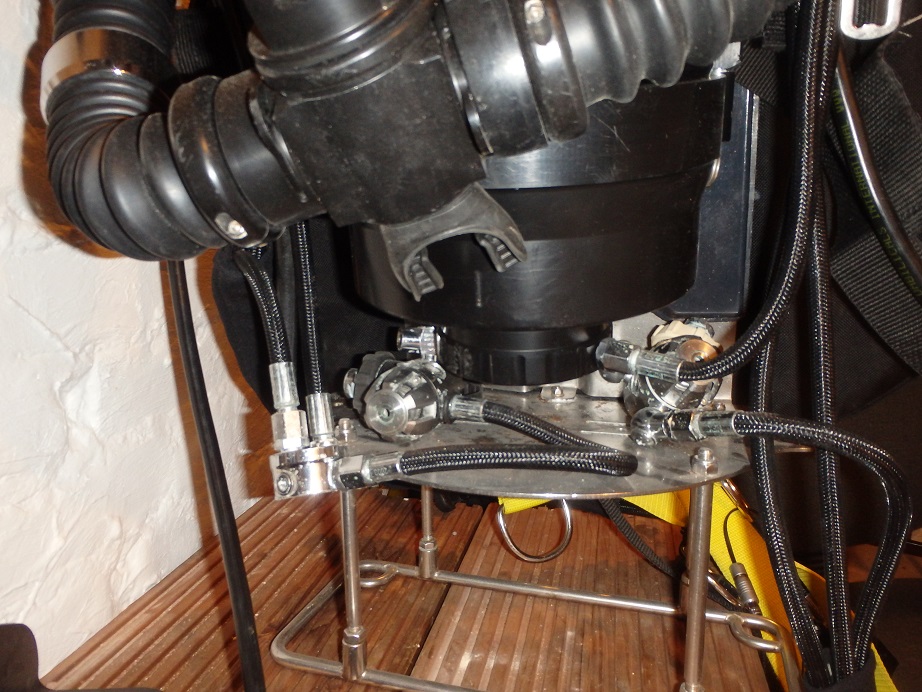
The stand.
This is significant enough to go on a page of its own. Click the picture for
the link if you want all the pictures of putting it together and adjusting
things. However remember it is the prototype not the Kent Tooling final
product.
Right so how are we doing?
Well it balances nicely in the water. I know I need a lot of weight, but that's
what wearing 300gm undersuits and quilted booties does for you. I am currently
running 7.4Kg on my belt and 2.6Kg in each 'ear' pocket in fresh water which
gives me enough suit inflate gas to stay warm. It does seem a bit excessive but
it works and it's effortless to stay at a nice horizontal trim and I like that.
That weight includes having my FaMi can lamp installed by the way.
The new DSV knob turned up and was a vast improvement. You can work it in cold
water gloves. I'm still perplexed that the original ever got past initial
tryouts. They must all have really strong fingers at Delta-P.
One other tweak I needed was to get a longer suit inflate hose. I had a 70cm
one but that just went tight standing with the rig on out of the water. Another
5cms would probably have been enough but I bought the 90cm one.
I bought a pair of 'replacement' trim weight pockets, the ones that go behind
your ears, and put them on the top of the new bottom plate to carry some of the
weight. They swallowed two blocks leaving me 4Kg of shot for fresh and 7 or 8Kg
for salt in the belt. That means if I nuke the suit totally and run into
buoyancy trouble I can dump the belt and I'm cold but neutral. (Yes I tried
flooding the suit in the pool by opening the zip right up and it cost me 7kgs
to get back to neutral).
With on-board lead, suit inflate and other kit the beast is admittedly very
heavy all kitted up but it is now so easy to get into and move around that it
pays you back for integrating everything.
Incidentally my original problem with stages has now gone. I have kitted up my
two 300bar 12litre cylinders both on land and in the water with no worries. I'm
not sure that really makes all the grief of changing over from the Inspiration
really worth while but at least it did deliver what was promised.
This is the Kent Tooling handle I bought at the 2010 London dive show. I'm
hoping it makes the beast more RIB friendly but only time will tell on that
one. I think John's done a nice job of missing the loop hose without it getting
in the way and the bolts are tapped into the plate. They were a bit long so
they met my friend Mr. Angle Grinder to take them down a bit so they didn't
press into the wing on full surface inflate. Either way it's another problem
dealt with.
It turns out to have the added bonus that you can tuck the mouthpiece behind it
when you're kitting up and it's nicely in reach when you want to put your hands
back and pull the loop over your head. This was never so easy before.
OK there is a snag. Grabbing the handle too vigorously to stand it up when it
was lying on the bench actually bent the back plate a bit. I don't think it's
a fault, just something to be careful of. Either way I'm hoping for a longer
plate in 5mm steel which should eliminate any bending and take some more off my
belt.
So what else has happened?
Well I dismantled the gas connection system. I had snagged the connectors up on
the loop so many times I decided it was making an incident more likely rather
than reducing risk. I quite like the idea of being able to plumb in off-board
gas that isn't attached to me to feed the loop but this system isn't the way
for me. Currently I have the BOV plumbed into the FRM (Funny Round Manifold) so
it's good for a quick sanity breath but you have to get off the loop ASAP in
the event of a real problem.
Even after wandering round a dive show with the measurements in my head I still
didn't have a nice solution to mounting my FaMi can lamp battery. It wanted to
go somewhere round the back but I wasn't not sure where was just right. It was
annoyingly too long at 8.5 inches to go between the uprights of the stand but
too short to attach to them. I felt a metal fabrication solution coming on so
I found a bit of 2.5mm stainless steel plate, hack-sawed out a T shape, dug
some spare jubilee clips out of the old-dive-kit-box plus a M8 bolt with a wing
nut and this is what happened.
OK it's dissimilar metals hard against one another so I need to remember to
keep it washed down or it will grow white fuzzy bits in time but it is a nice
positive fitting and at home I can just plug the charger in on the
bench.
An apology:
I'm an old twit. I did my school physics in metric and my carpentry, metalwork
and engineering drawing in imperial. I switch between the two systems
seamlessly. If it confuses you I'm sorry.
Rebuild pictures